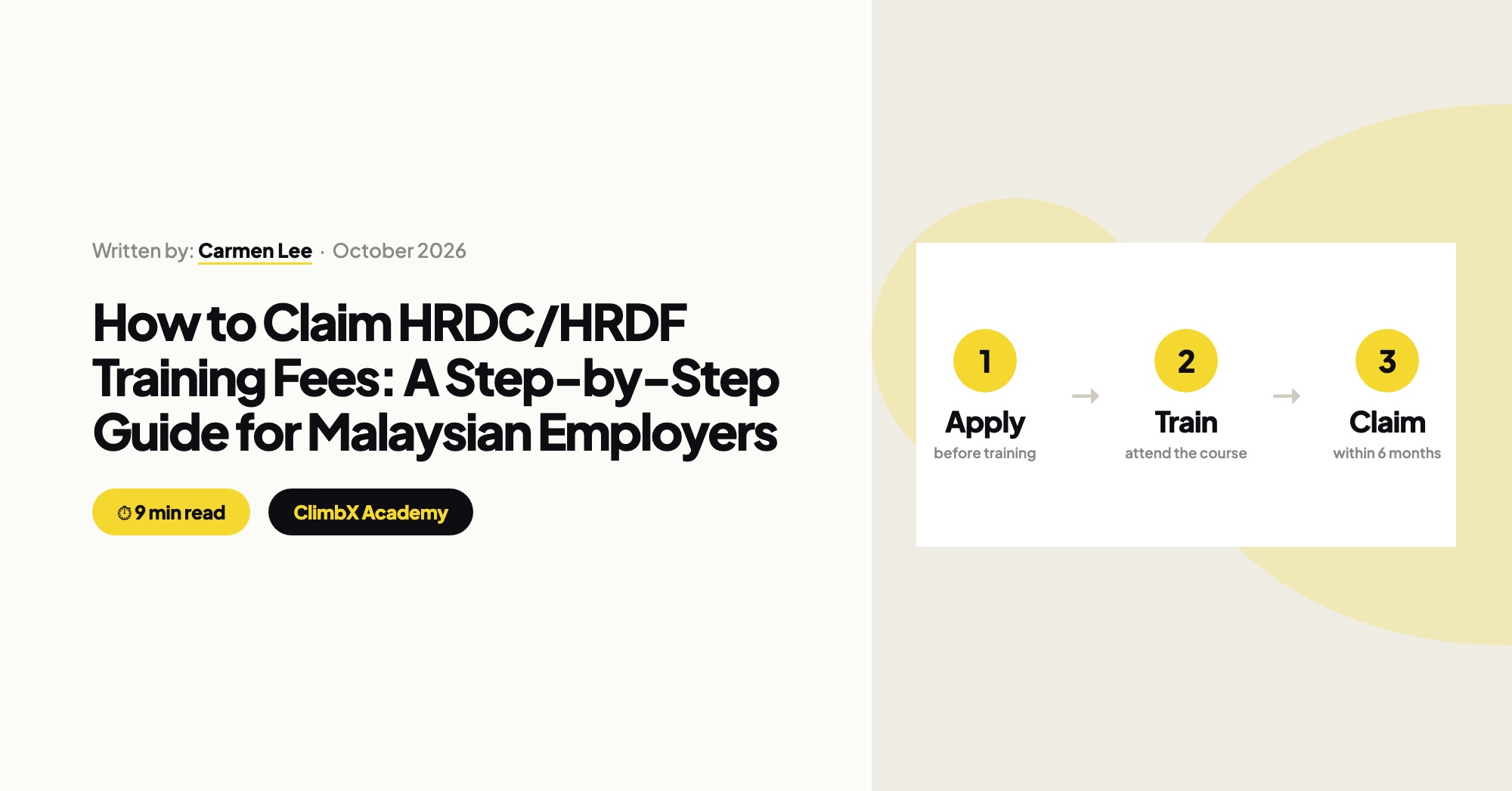
To claim HRDC/HRDF for a training course, a registered employer applies for the grant in eTRiS before the training starts, waits for approval, sends staff to the course, and then claims after the training provider has submitted its own claim. The two points where most claims go wrong are applying too late and missing the six-month claim window.
Why do HRDC/HRDF claims stall after the course is booked?
In many organisations the course is chosen first and the grant is treated as paperwork to sort out afterwards. The rules run the other way round. HRDC/HRDF’s own guidance says grant applications must be submitted online before the training commences, and the approval has to be in place before the class date, with a waiting period that depends on the type of training.
The same pattern repeats at the other end. The provider’s claim and the employer’s claim are separate steps, there is a six-month window after the training ends, and the attendance record cannot be corrected by the employer once it has been approved. Each step is simple on its own. The problems come from nobody owning the sequence.
What should you check before you book a course?
Three checks take ten minutes and prevent most rejections.
- Is your company registered? HRDC/HRDF says registration is compulsory for employers with 10 or more Malaysian employees, and optional for employers with five to nine. Registered employers pay a monthly levy of 1% (mandatory category) or 0.5% (optional category) of monthly wages plus fixed allowances.
- Is your levy account in order? Employers with outstanding levy and interest are not eligible to apply for the financial assistance, and the course fee is debited from your levy account.
- Is the course registered with HRDC/HRDF? Since 1 April 2021, grant applications for courses that are not registered under the SBL-Khas scheme are no longer approved, apart from some specific types of training. Ask the provider for the registered course title.
How do you apply for the grant, and how early?
Applications are made in the employer’s eTRiS account. HRDC/HRDF asks for three documents: an invoice or quotation for the course fee, the trainer’s profile, and the schedule or course content. Your training provider should supply all three.
The timing rules changed in 2026, so check them against the dates in the table below before you commit to a class.
- In-house training: from 15 June 2026, training can begin 14 days after the grant is approved.
- Public training, 15 June to 31 December 2026: training can begin three days after approval.
- Public training from 1 January 2027: the 14-day rule applies, the same as in-house.
- All formats: the programme must start within 90 calendar days after the waiting period ends.
Group size also differs. For HRDC/HRDF Claimable Courses, one grant application covers 1 to 9 participants for public training and 2 to 50 for in-house training. A team of 12 is therefore an in-house training conversation, or two applications.
What happens after the training, and who claims first?
For HRDC/HRDF claimable courses, the training provider submits its claim first, and the employer submits its own claim only after the provider’s has been approved. The provider enters and attaches the trainee attendance, and the employer then reviews it in eTRiS. Because the employer cannot amend attendance once it is approved, check the sign-in sheet on the day.
All claims must be submitted within six months after the training is completed. The employer does not have to pay the course fee to the provider. The fee is debited from the levy account, and a provider may ask for an upfront payment of up to 30% only with the registered employer’s consent. If this is your company’s first claim, register your bank account for e-disbursement first, because the claim cannot proceed without it.
Can you use HRDC/HRDF to buy training software as well?
Yes, within limits. Under the Computer-Based Training (CBT) scheme, HRDC/HRDF’s Allowable Cost Matrix guidebook (January 2026 version) covers the purchase of training software, the development of a learning management system (LMS), a subscription to an LMS for training purposes only, and subscriptions to e-learning training content platforms. Claims are reimbursed against actual receipts.
The conditions are what trip people up:
- It must be training software. Purchased software must be solely for training and learning, contain interactive courses that let users learn a skill without an instructor, and let users evaluate their progress.
- Everyday work software is excluded. The guidebook names Microsoft Office, accounting software, AutoCAD and programming software as not covered, along with display or reading material such as e-books and safety procedures. It does not list AI assistants, so do not assume a subscription to one is covered. Ask HRDC/HRDF before you buy.
- Subscriptions and development need a grant first. Developing your own training software or an LMS, or subscribing to an LMS or an e-learning content platform, needs prior grant approval. The grant is based on your quotation, and the reimbursement on the receipt.
- Off-the-shelf software has a different route. Purchased training software does not need a grant, but HRDC/HRDF’s claims unit must see the software in its original form before it allows the claim.
The guidebook’s own wording on lead time for subscriptions is not entirely consistent with HRDC/HRDF’s circular FAQ, which refers to applying one month before the training start date, so confirm the lead time with HRDC/HRDF before you commit to a subscription.
Who in your company should own the claim?
Name one person for every grant, usually in HR or L&D, and give them three dates to put in the calendar: the day the application must be approved, the course start date, and six months after the course ends. Ask the provider for the documents at the time of booking, not afterwards. After each course, the manager should confirm that the attendance sheet matches who actually sat in the room before anyone submits.
What improves when you run claims this way
- Staff are not turned away because the grant was approved too late for the class date.
- Claims reach HRDC/HRDF with accurate attendance, so fewer queries come back.
- Nothing expires unnoticed in the six-month window.
- Managers know in advance what the company pays and what is drawn from the levy.
How ClimbX supports the claim
ClimbX Academy is an HRDC/HRDF registered training provider in Kuala Lumpur, running both in-house and public courses. When you book, we give you the details the grant application asks for: the course title, trainer profile, schedule and invoice or quotation. We submit our claim after the class so yours can follow. Sessions use role-play and realistic workplace scenarios, and reinforcement afterwards helps your team use the skill on the job. All ClimbX programmes are HRDC/HRDF claimable.
What to do next
If you are planning a course and are not sure when the grant has to be approved, send the course title, your preferred dates and the number of participants to hello@climbxacademy.com. We will reply with the latest date the application should be approved and the documents you will need, so you can judge the timing before deciding anything.
Frequently asked questions
How early do I need to apply for an HRDC/HRDF grant before the training date?
At least two weeks before the training date, and earlier if you want room for queries. HRDC/HRDF’s earlier guidance asked employers to apply at least one day before the training commences, and public courses could start three days after approval. Under the current rules, training can begin only 14 days after the grant is approved. The 14-day rule has applied to in-house training since 15 June 2026 and applies to public courses from 1 January 2027, when the three-day gap for public courses ends. In practice, companies now need to plan their training calendar in advance and give their training provider the course details early enough for the application to be submitted and approved.
What is the difference between HRDC, HRDF and HRDC/HRDF?
They refer to the same organisation at different points in its history. It began in 1993 as the Human Resources Development Council (HRDC), and was widely known as HRDF, the Human Resources Development Fund. In April 2021 it became the Human Resource Development Corporation, which many people still call HRDF. This guide writes HRDC/HRDF to cover both names.
Can a company with fewer than 10 employees claim HRDC/HRDF?
Registration is optional for employers with five to nine Malaysian employees. If you register, you pay a levy of 0.5% of monthly wages plus fixed allowances and can apply for grants. Employers with fewer than five Malaysian employees are outside the registration categories on HRDC/HRDF’s FAQ page.
How long do I have to submit the claim after training?
Six months after the training is completed. The training provider’s claim goes in first, and the employer submits its claim after that approval.
Do I have to pay the training provider before I claim?
No. HRDC/HRDF says the employer does not need to pay the training fees to the provider. The fee is debited from the levy account, and a provider can ask for an upfront payment of up to 30% only with the employer’s consent.
How many people can I send on one public course grant?
For HRDC/HRDF Claimable Courses, a public training application covers 1 to 9 participants. In-house training applications cover 2 to 50.
Can I claim software or an e-learning subscription under HRDC/HRDF?
You can claim training software, an LMS subscription for training purposes only, and subscriptions to e-learning training content platforms under the Computer-Based Training scheme, but not everyday work software such as Microsoft Office or accounting packages. Subscriptions and software development need grant approval first, and reimbursement follows the actual receipt.
Sources
- Pembangunan Sumber Manusia Berhad (HRDC/HRDF), Claimable Courses: application before training, timing rules (14 days; three days for public training until 31 December 2026), 90-day start window, claims within six months
- Pembangunan Sumber Manusia Berhad, Support Centre: Claimable Courses (SBL-KHAS) grant application: required documents, participant limits, levy arrears, upfront payment
- Pembangunan Sumber Manusia Berhad, Support Centre: Claim by the training provider: provider claims first, attendance, six-month deadline, seven working days processing
- Pembangunan Sumber Manusia Berhad, Support Centre: Steps for employers to submit a claim: eTRiS steps, e-disbursement registration
- Pembangunan Sumber Manusia Berhad, Support Centre: General FAQs on grant applications: application before training, registered courses from 1 April 2021
- Pembangunan Sumber Manusia Berhad, Employers FAQ: who must register, 1% and 0.5% levy
- Pembangunan Sumber Manusia Berhad, About us: HRDC (1993), the April 2021 name change
- Pembangunan Sumber Manusia Berhad (HRDC/HRDF), Allowable Cost Matrix guidebook, January 2026 version (pages 12 to 13): Computer-Based Training scheme, software purchase and development, LMS and e-learning subscriptions
- Pembangunan Sumber Manusia Berhad, Support Centre: Employer’s Circular 3/2024 FAQ: claimable CBT items, LMS subscription for training purposes only, claim timing
- Pembangunan Sumber Manusia Berhad (HRDC/HRDF), Grant Helper: Claimable Courses (v2022): the earlier rule to apply at least one day before training commences