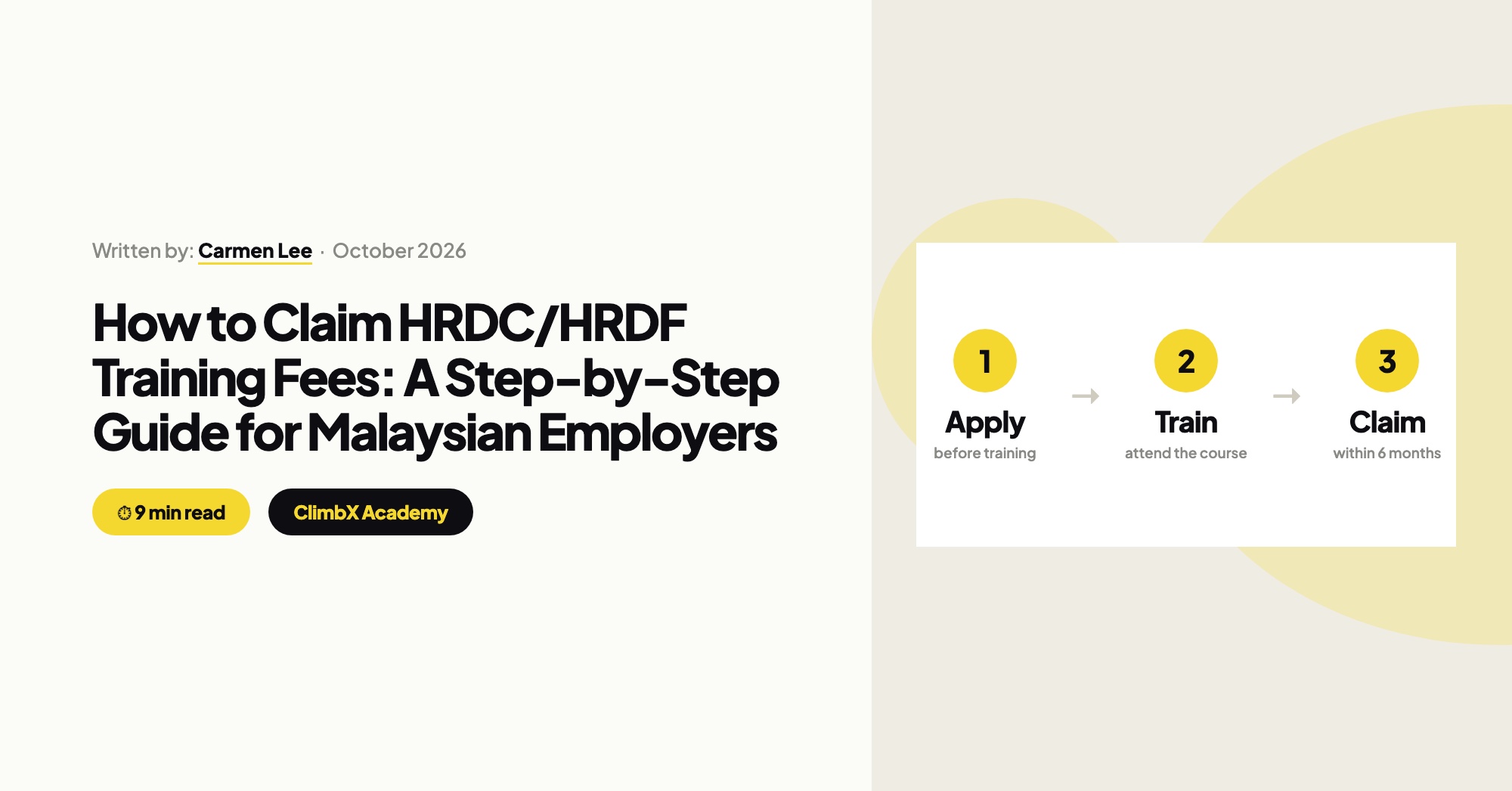
Many companies still plan training the same way: choose a few courses late in the year, submit the grant application shortly before the class, and sort out attendance records afterwards. That approach no longer works for HRDF claimable training. Since June 2026, HRDC/HRDF has tightened how grants are approved and how training is verified, and public training follows the same stricter timeline from 1 January 2027.
The short answer is to plan earlier and plan from real needs. Start with a training needs analysis (TNA), rank what matters most, and build your calendar backwards from each training date so approval is in place well before the class begins.
What has changed for HRDC/HRDF claimable training
Three changes matter most for employers planning 2027.
Training can only start 14 days after grant approval. Since 15 June 2026, in-house training can be conducted 14 days after the grant is approved, according to HRDC/HRDF’s Claimable Courses page. Public training has a shorter three-day window until 31 December 2026, and returns to the 14-day rule from 1 January 2027. Applications must be submitted before the training starts.
More applications are being rejected. HRDC/HRDF’s chief executive, Datuk Shamir Aziz, reported that the approval rate fell from 93.1% to 78.8% under the stricter screening, as reported by The Star. Roughly one application in five is not getting through.
Verification is now routine. The Star reports that HRDC/HRDF verified 19,322 training sessions between June and September 2026, about three times the 6,231 programmes verified in all of 2025. A digital attendance system using MyDigital ID, QR codes, geotagging and timestamps is planned for pilot in 2027.
Why last-minute training plans now put your levy at risk
Under the new rules, a late application leaves no room for a rejection to be fixed and resubmitted. Training is often planned reactively: a department asks for a course, HR looks for a provider, and the application goes in close to the date. If that application is rejected, the training date moves, momentum is lost, and the levy you meant to use stays unused.
This rarely comes from a lack of training needs. It comes from a planning sequence that starts with the course instead of the need.
Start with a training needs analysis, not a course list
A course list answers the question “what training is available?” A TNA answers the more useful question: “what does each role need to do better in 2027, and where are people falling short?” A practical TNA follows four steps:
- Agree 3–5 business priorities for 2027 with management and department heads, and identify the roles that drive them.
- Build a competency profile for each priority role. List 6–10 competencies and set the required level for each on a simple 1–5 scale, with a short description of what each level looks like on the job.
- Map current levels using at least two sources, such as a self-assessment and a manager assessment, plus one objective source like KPIs or call reviews.
- Calculate the gap between required and current levels for each team.
Check whether each gap is really a training problem
Not every gap needs a course. Ask one question: if their job depended on it, could they do it? If the answer is no, it is a skill gap and training will help. If the answer is yes but they still don’t, the cause is usually unclear expectations, missing tools or a broken process. Training will not fix that, and spending levy on it wastes a scarce approval.
Rank the gaps and match them to the right HRDC/HRDF scheme
Score each gap by its size, its business impact and the number of people affected, then fund the highest-priority needs first. HRDF claimable training is not limited to classroom courses: HRDC/HRDF also runs other levy-funded schemes, such as Skim Bantuan Latihan (SBL), Skim Latihan Bersama (SLB) and Future Workers Training (FWT), as Panda HRMS’s summary of the revised grant terms lists. Matching each need to the right scheme helps you use more of your levy.
Count back from the training date, not forward from the application
For each programme, work backwards. Approval must be in place at least 14 days before training. Before that, allow time for HRDC/HRDF’s review and a possible resubmission, then your own internal sign-off, and before that, a confirmed trainer, venue and course outline. For a class on 20 January 2027, that means submitting in mid-December, not early January. Note also that key details of an approved grant, such as dates, venue, trainer and participant list, cannot be amended; the grant has to be cancelled and resubmitted, so confirm them before you apply.
Keep attendance and delivery records inspection-ready
Make sure every session matches the approved application: date, venue, trainer and participants. Record attendance accurately for each day, and keep evidence of delivery. Assign one named person to own verification for each programme.
What improves when training is planned this way
Applications go in with time to spare, so a rejection becomes a delay rather than a cancelled class. Levy is directed at the gaps that affect business results, rather than at whichever course was requested first. Managers know what each programme is meant to change, so they can follow up after training. And when HRDC/HRDF checks a session, the records are already in order.
It is also worth tracking what is coming but not yet claimable: a revised Allowable Cost Matrix (consultation continues to the end of 2026), company-sponsored degrees and scholarships targeted for 2027, and claimable CPD points. Plan for them, but don’t budget for them until official guidelines are issued.
How ClimbX helps you plan and deliver training that is claimed on time
ClimbX Academy helps employers identify the skill gaps that matter, then turns them into training built for Malaysian workplaces. Our programmes use role-play and realistic scenarios rather than lectures, and we support managers to reinforce the skills on the job after the workshop. For teams adopting AI, our AI course in Malaysia public programmes cover practical AI for business, sales and marketing, with clear guidance on where human judgement must stay in charge. All ClimbX programmes are HRDC/HRDF claimable, and we plan schedules around the 14-day approval rule.
If you want a structured starting point, check where your 2027 training plan stands, or download our free 2027 Training Planning Framework, which walks you through the full TNA, from competency mapping to an approval-ready calendar, with ready-to-use AI prompts for building your own forms.
Want a second opinion on your plan? Send your current 2027 training plan or TNA template to hello@climbxacademy.com. Remove anything you prefer to keep private. We will return it with comments on where the gaps, priorities and timelines could be tighter, so you can judge the value before deciding anything.
Frequently asked questions
What is HRDF claimable training?
HRDF claimable training is training whose cost an employer registered with HRDC/HRDF can claim from its levy account. The training must fall under an approved scheme, such as HRDC/HRDF Claimable Courses, and the application must be approved before the training takes place.
How early do I need to apply for HRDC/HRDF claimable training?
Apply early enough for approval to be in place at least 14 days before in-house training starts. This rule has applied since 15 June 2026. Because the 14 days count from approval, not submission, submit well ahead and allow time for HRDC/HRDF’s review and any resubmission.
Does the 14-day rule apply to public training?
Yes, from 1 January 2027. Until 31 December 2026, public training can be conducted three days after grant approval. From 2027, public training follows the same 14-day rule as in-house training, so employers sending staff to public courses in early January should apply in December.
Can HRDC/HRDF approve a grant after the training has taken place?
HRDC/HRDF requires employers to submit the application before the training starts, and the training can only be conducted after approval. Treat approval after the event as unavailable, and build buffer time into your plan so a rejected application does not cost you the class.
Are degrees and CPD points HRDF claimable?
Not yet. HRDC/HRDF aims to make company-sponsored degrees and levy-funded scholarships claimable from 2027, and is working on making CPD points for professionals claimable. These are plans, not current entitlements, so wait for official guidelines before budgeting for them.
Sources
- HRDC/HRDF, Claimable Courses (14-day rule and public training window)
- The Star, A new blueprint for building talent (25 Oct 2026)
- Bernama, HRDC/HRDF reforms (18 Oct 2026)
- Panda HRMS, HRDC/HRDF revised grant terms