In many Malaysian companies, the annual training plan starts with a request rather than a need. A department head asks for a course, HR looks for a provider, and the programme goes ahead because the levy is available. A year later, it is hard to say what changed. A training needs analysis fixes this by asking a different question first: what does each role need to do well, and where are people actually falling short?
A training needs analysis (TNA) is a structured way to compare the skills a role requires with the skills people currently have, then decide which gaps training should close first. For Malaysian employers, it also turns the training budget into a plan that fits HRDC/HRDF approval timelines, instead of a list of courses chosen at the last minute.
Why course-first planning keeps missing the real gaps
Course-first planning feels efficient. Popular topics are easy to choose, providers are easy to compare, and the levy covers the cost. The problem is that a course title says nothing about the specific gap it is meant to close. A “Customer Service Excellence” programme may help a front desk team that struggles with complaints, but it will not help much if the real issue is that staff are not allowed to offer a remedy without a supervisor.
This matters more now. HRDC/HRDF’s approval rate fell from 93.1% to 78.8% after stricter screening was introduced, as reported by The Star, and in-house training can only begin 14 days after grant approval. Training that is chosen without a clear purpose is harder to justify, schedule and evaluate.
How to conduct a training needs analysis in five steps
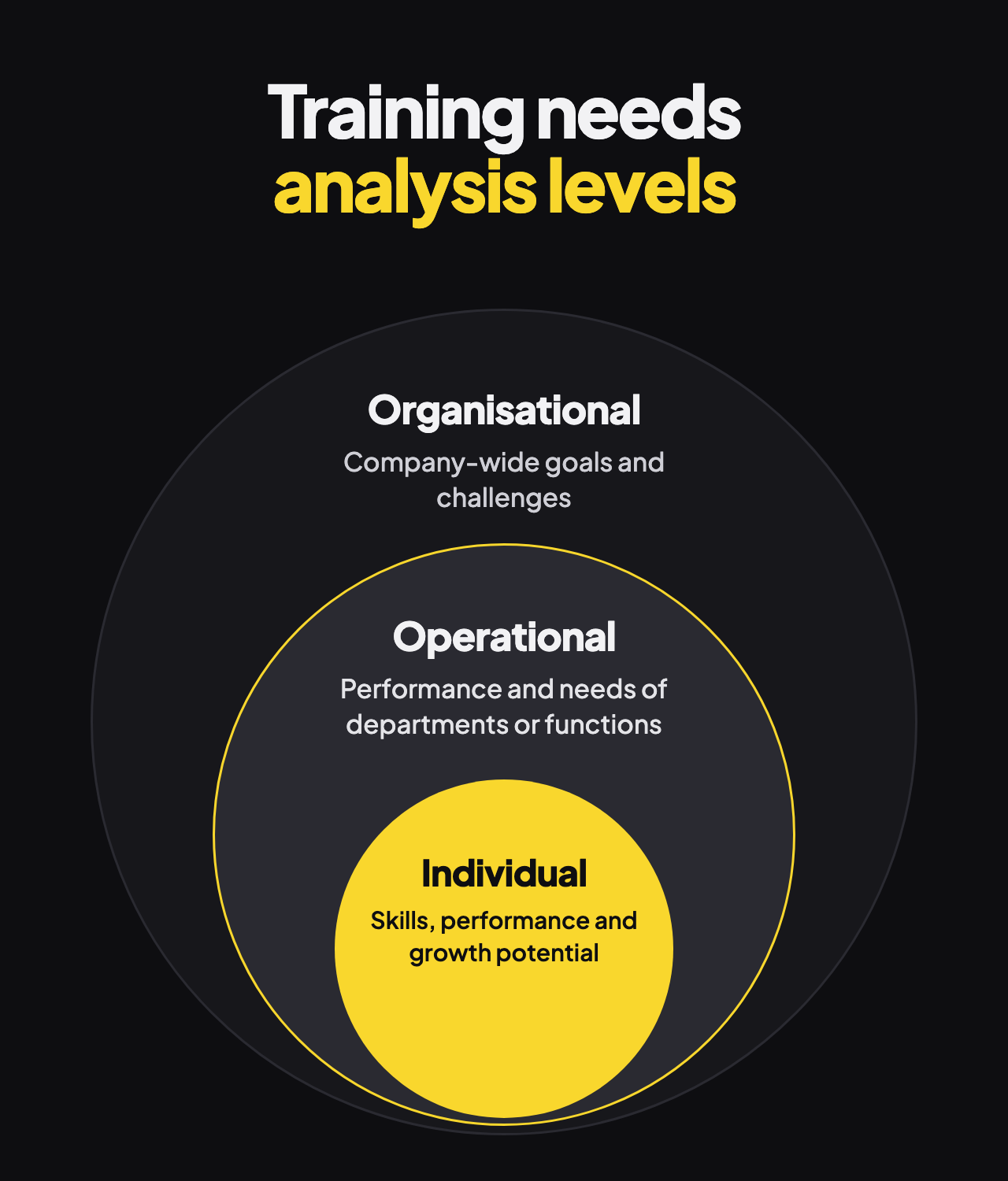
A TNA works at three levels. The organisational level covers company-wide goals and challenges. The operational level looks at the performance and needs of departments or functions. The individual level assesses each person’s skills, performance and growth potential. The five steps below move from the first level to the last.
Start with three to five business priorities for the year
Before looking at individual employees, agree with management what the business needs from its people. Examples include reducing customer complaints, improving key-account renewals, preparing supervisors for a new site, or getting teams to use AI tools safely. Then name the roles that drive each priority. This keeps the analysis focused on the work that matters most, rather than every role at once.
Build a competency profile for each priority role
List six to ten competencies per role, grouped into core skills that everyone needs, functional skills specific to the role, and leadership skills for people managers. Set a required level for each on a simple 1–5 scale, and describe what each level looks like on the job. “Resolves standard complaints within policy and follows up without being reminded” is something a manager can observe. “Good customer service” is not.
Assess current levels from more than one source
A self-assessment alone is unreliable, so combine it with a manager assessment and one objective source, such as KPIs, call reviews or a mystery shop. Where the self-rating and the manager’s rating differ by two levels or more, talk it through before finalising the score. These differences often reveal unclear expectations rather than a lack of skill.
When I was in L&D, we used both self-assessments and manager assessments, because some people rate themselves too high and others too low, and we wanted a more complete picture. Collecting all of that took time, so we set up a Google Form and a Google Sheet for each department, which made the process much faster. We also noticed that many departments did not know where to start when choosing training, so we researched the programmes relevant to our industry and listed them, giving each department a starting point to work from.
Separate training gaps from system problems
For each gap, ask: if their job depended on it, could they do it? If the answer is no, it is a skill or knowledge gap, and training can help. If the answer is yes but they still don’t, the cause is usually missing tools, an unclear process, a lack of authority or no follow-up from the manager. Training will not fix those, and spending levy on them uses up an approval you could have used elsewhere.
Rank the gaps and turn them into a training plan
Score each gap on three factors: how large it is, how much it affects business results, and how many people it affects. Fund the highest-scoring gaps first. For each one, write a learning objective that describes observable behaviour, choose the right format (in-house, public, on-the-job or coaching), and match it to the right HRDC/HRDF scheme. Then build your calendar backwards from each training date, so grant approval is in place at least 14 days before the class, as required under the HRDC/HRDF Claimable Courses scheme.
Adapting your training needs analysis to Malaysian workplaces
A framework imported unchanged often fits poorly on the ground. A few adjustments make the analysis more accurate for local teams.
Run assessments in the language people work in. In multilingual workforces, a form written only in English can measure language ability rather than job skill. Offer forms in Bahasa Malaysia, English or Mandarin where needed, and keep the behaviour descriptions short and concrete.
Plan for frontline and shift-based teams. Manufacturing alone accounted for 26% of HRDC/HRDF approvals, according to the same report. Many of these employees do not sit at a desk. Use short mobile-friendly forms, supervisor-led observation checklists and assessment windows that fit around shifts.
Make it clear the assessment is for development, not appraisal. Where staff worry that a low self-rating will affect their bonus, scores drift upwards. Explain who sees the results and how they will be used, and keep the TNA separate from the performance review cycle.
Respect approval layers. In many organisations, a training plan needs sign-off from department heads, finance and sometimes the owner. Build those steps into your timeline so internal approval does not eat into HRDC/HRDF’s 14-day window.
Protect personal data. Competency ratings are personal data. Tell employees why you are collecting them, limit access to those who need it, and store them in line with the Personal Data Protection Act 2010.
What a good training needs analysis template should include
You do not need specialist software. A practical training needs analysis template usually includes:
- A business priorities worksheet for management
- Role competency profiles with required levels and behavioural indicators
- Matching self-assessment and manager assessment forms
- A gap matrix that calculates gaps and priority scores automatically
- A training plan that lists programmes, schemes, costs and backward-planned dates
- A short list of relevant programmes for your industry, so department heads have a starting point when matching gaps to training
Google Forms or Microsoft Forms can collect the ratings, which then flow straight into a spreadsheet for analysis. AI tools can help draft competency profiles and form questions quickly, but HR and department heads should review every draft, and real employee data should never be pasted into public AI tools.
What improves when you plan from a TNA
Training requests come with a clear reason attached. Levy goes to the gaps that affect business results, rather than to whichever course was requested first. Managers know what each programme is meant to change, so they can follow up on the job afterwards. And when you re-assess the same competencies six months later, you can show what actually moved, which gives you the starting point for next year’s analysis.
How ClimbX supports your training needs analysis
ClimbX Academy works with Malaysian employers to identify the skill gaps that matter and turn them into practical training. Our programmes use role-play and realistic workplace scenarios, and we help managers reinforce new skills on the job after the workshop. Where your TNA points to AI skills, our public programmes are a practical AI course in Malaysia for business, sales and marketing teams, with clear guidance on where human judgement must stay in charge. All ClimbX programmes are HRDC/HRDF claimable.
To get started, download our free 2027 Training Planning Framework. It is a complete training needs analysis template, from competency mapping to an approval-ready calendar, with AI prompts for building your own forms. You can also check where your 2027 training plan stands. For the latest approval rules, read our guide on how to plan HRDC/HRDF claimable training for 2027.
Want feedback on your current approach? Send your existing TNA form or 2027 training plan to hello@climbxacademy.com, with names or anything confidential removed. We will return it with annotated comments on where the competencies, gaps and priorities could be sharper, so you can judge the value before deciding anything.
Frequently asked questions
What is training needs analysis?
Training needs analysis is a structured process for identifying the gap between the skills a role requires and the skills employees currently have. It helps employers decide which gaps training should address first, which ones need a different fix, and how to spend the training budget or HRDC/HRDF levy on what affects business results.
How do you conduct a training needs analysis?
Start by agreeing on business priorities and the roles that drive them. Build a competency profile for each role, assess current levels using self, manager and objective sources, and calculate the gaps. Then separate skill gaps from system problems, rank the remaining gaps by impact, and turn the top priorities into a training plan.
What should a training needs analysis template include?
A useful training needs analysis template includes role competency profiles with required levels, matching self and manager assessment forms, a gap matrix that calculates gaps and priority scores, and a training plan listing programmes, formats, costs, HRDC/HRDF schemes and approval dates. Many employers also add a short list of relevant programmes for their industry.
How long does a training needs analysis take?
A focused training needs analysis for a few priority roles usually takes about four to six weeks. That covers agreeing priorities, building competency profiles, running assessments, analysing gaps and drafting the plan. Starting in the fourth quarter gives Malaysian employers time to secure HRDC/HRDF approvals before first-quarter training begins.
Why is training needs analysis important?
Training needs analysis makes sure training targets real skill gaps instead of popular course titles. It helps employers avoid spending levy on problems that training cannot fix, gives managers a clear standard to coach against after training, and provides a baseline for measuring whether the training actually changed performance.
Sources
- The Star, A new blueprint for building talent (25 Oct 2026)
- HRDC/HRDF, Claimable Courses (14-day rule)